Publications
My work spans numerical methods for geometric PDEs, surface finite elements, structure-preserving discretizations, and scientific software. The selections below highlight several recent questions, my contribution to each project, and the research directions that emerged from them.
Selected publications
2026 SHAPE ANALYSIS · CURVED SURFACES
Surface Minkowski tensors to characterize shapes on curved surfaces
Lea Happel, Hanne Hardering, Simon Praetorius, and Axel Voigt
Interfaces and Free Boundaries · 2026 · DOI
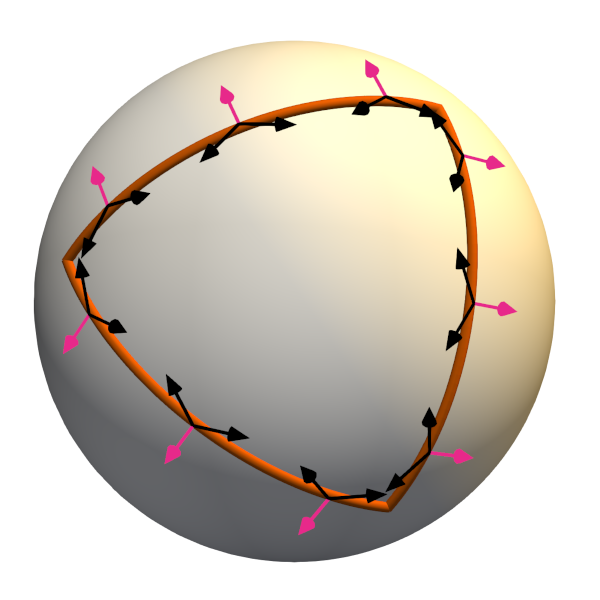
This work introduces surface Minkowski tensors for characterizing the rotational symmetries of shapes embedded in curved surfaces. A modified transport of the boundary co-normal avoids the angular defect introduced by classical parallel transport and makes the construction practical on general surfaces and for different shape representations.
The paper is deliberately different from much of my finite-element work. Its central question is how to describe shape. It has opened several directions I would like to pursue, including geometric flows that preserve a Minkowski measure and flows that optimize one. One example is a flow that evolves a curve toward a regular triangle or quadrilateral.
2025 GEOMETRIC FLOWS · STRUCTURE PRESERVATION
Isoparametric finite element methods for mean curvature flow and surface diffusion
Harald Garcke, Robert Nürnberg, Simon Praetorius, and Ganghui Zhang
Journal of Computational Physics 539, 114248 · 2025 · DOI
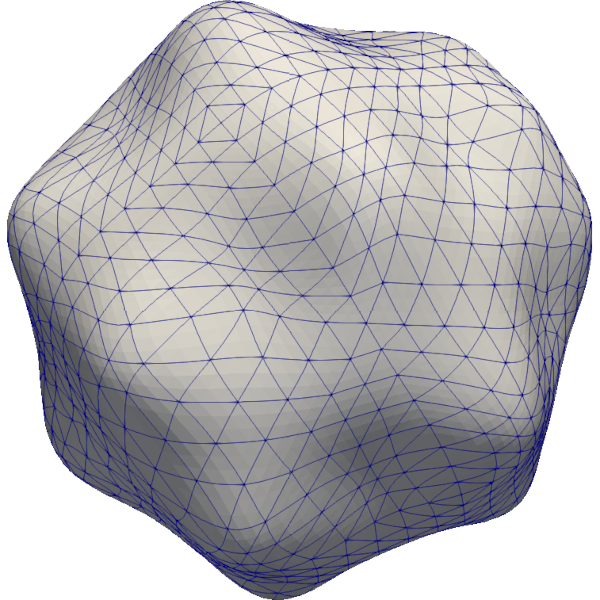
We developed higher-order isoparametric finite-element approximations for mean-curvature flow and surface diffusion. The schemes retain the unconditional energy stability and favorable mesh quality of the original piecewise-linear methods. The structure-preserving surface-diffusion variant additionally conserves enclosed volume.
Implementing the structure-preserving scheme made its mechanisms particularly tangible and suggested a broader question: can structure preservation be formulated as a more general design principle for geometric evolution methods?
2025 SURFACE STOKES · ERROR ANALYSIS
Parametric finite-element discretization of the surface Stokes equations
Hanne Hardering and Simon Praetorius
IMA Journal of Numerical Analysis 45(5), 2948–2987 · 2025 · DOI
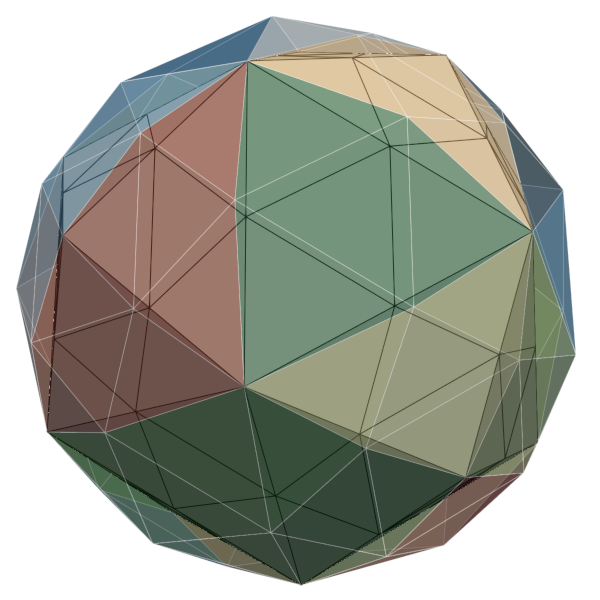
This is the result of a long collaboration with Hanne Hardering. We developed a general route for transferring finite-element pairs with known inf–sup stability on flat domains to surface problems, and analyzed four discretizations of the surface Stokes equations within a single framework.
Handling these formulations together was challenging, but it made the decisive interaction clear: the approximation of the geometry and the discretization of the PDE cannot be designed or analyzed independently. Their approximation orders and consistency properties have to be coupled.
A foundational collaboration
2022
Tangential errors of tensor surface finite elements
Hanne Hardering and Simon Praetorius
IMA Journal of Numerical Analysis 43(3), 1543–1585 · DOI
Our first joint paper began with a deceptively simple question. When tangentiality of a vector- or tensor-valued surface PDE is imposed through a penalty term, is a higher-order approximation of the surface normal required for optimal error estimates? It turns out that it is not. The normal of the discrete geometry is sufficient for optimal convergence of the tangential quantities. Establishing that result required a careful distinction between tangential and normal errors throughout the analysis.
Recent preprints
GEOMETRIC SUPERCONVERGENCE · 2026
Odd behaviour of even geometries
Hanne Hardering, Simon Praetorius, and Gentian Zavalani
arXiv:2607.29466
This preprint grew from an observation in our surface Stokes experiments: curvature was approximated more accurately than our theory predicted. We trace this even–odd effect to cancellation of leading interpolation errors on suitably structured meshes. For even-order surface approximations, that cancellation improves weighted integral estimates for quantities including surface normals, the Weingarten map, and Gaussian curvature. We are now seeing the same phenomenon appear in several other projects.
DUNE · SOFTWARE CONCEPTS · 2026
Concepts for composing finite element function space bases
Christian Engwer, Carsten Gräser, Steffen Müthing, Simon Praetorius, and Oliver Sander
arXiv:2508.10125
Coupled multiphysics problems naturally use finite-element spaces assembled from several subspaces. This paper develops a tree-based abstraction for describing those composed bases and deriving flexible multi-index numberings from their structure. The resulting framework decouples the mathematical organization of the basis from the data layout, allowing the same finite-element code to work with different linear-algebra structures and solver backends. The concepts are realized in the dune-functions module of the DUNE ecosystem.
Looking for presentations related to this work? Browse invited talks and workshops →